

On the Perpetual Chess podcast, Ben Johnson (my guest on this week’s Friday livestream!) interviews chess players with a track record of success. They talk about their training techniques: tactics, calculation, analyzing their tournament games, and so on. But I’ve noticed there’s another technique, often whispered or mentioned in passing, so it’s easy to miss.
They always play blitz.
For example, in a recent episode, GM Alex Fishbein extolled the virtues of guess-the-move training (which I covered in-depth in last week’s livestream with Dalton Perrine). But he also mentioned in passing, “Of course, you have to play blitz.”
Another example: while doing live commentary on a game of his protégé Vincent Keymer, Peter Leko murmured, “I’m not sure if he has the hundreds of blitz games in this line to really feel the position.” In other words, even for Leko, a world championship contender with tremendous classical chess culture, hundreds of blitz games are part of the training.
As they say on The Hoop Collective, one of my favorite NBA podcasts, “Actions over words.” It seems that people don’t like to talk about it, but virtually everyone who’s any good at chess either plays or has played an enormous amount of blitz.
Here’s where someone inevitably brings up the Botvinnik blitz quote: “Yes, I have played a blitz game once. It was on a train, in 1929.” (In chess we call that prophylaxis by the way, where I already anticipate what you’re thinking.)
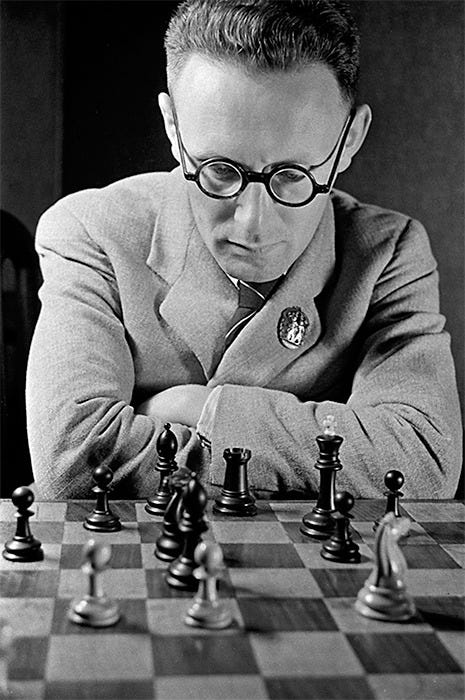
I am generally not a fan of the phrase “the exception that proves the rule” (clearly makes no sense), but if it ever applies, surely it’s here. Botvinnik is the only top player I’m aware of who even claims not to play blitz, and he was probably full of shit. I bet this guy was a regular Firouzja, playing marathon bullet sessions late into the night after he lost a tournament game. It just wasn’t on the internet back then.
My opinion, and I’m dead serious here, is that blitz is one of the most powerful improvement tools at your disposal.
The advantage of blitz is simple: you can play a lot of games quickly. And quantity has a quality all its own. If you want to improve at chess — especially if you’re starting at an adult — you’re going to need to get a lot of games under your belt. There are just so many patterns and possibilities in this great game. You’ll never get enough practice if each game takes hours to complete.
Many players and coaches come down on the side of “depth" not because there’s any evidence this is more efficient for improving your chess, but because it conforms with how they want chess to feel. Adults especially tend to get into chess because they want a deep intellectual experience.
Chess can provide that, but the reality of tournament chess is something different. New players show up expecting a duel and find themselves in a knife fight. The truth is that most games at all levels are decided by simple mistakes. It’s limiting these mistakes, not thinking deep thoughts, that will improve your results.
My friend Dan Bock has one of the more impressive track records you’ll see for making massive progress as an adult, going from 1547 to the brink of 2000. He wrote a great post about what he does to work on chess. One of the key elements? Lots of blitz. He plays a lot of classical chess, too!
There’s a clear tradeoff here. On a per-game basis, each blitz game will not be as deep as a classical tournament game, but you can play far more of them. There are obvious arguments on both sides of this tradeoff, and I’m not suggesting you should only play blitz. It’s one thing you should do, alongside slower games, puzzles, and various other training techniques. But you shouldn’t skip it.
Tilt
Why then do so many players avoid blitz? In a word, tilt.
The word “tilt” originates from pinball, where attempting to lift and manipulate the whole machine would cause it to display “TILT” and freeze the controls. It comes to chess by way of poker, where players tend to be highly aware of mindset issues.
In poker (and chess), tilt refers to those instances where your emotional state hampers your ability to play well. Most stereotypically, this would be raging over a loss — what you might call “full-blown monkey tilt” — but it can refer to any state of mind that cause you to play less than your best. Some poker players even consider being happy when you win to be a form of tilt.
The way this classically presents in blitz is as follows:
Lose a game, or a string of games
Lose your composure and start to play worse
Play longer than you intended, chasing rating losses
Finally admit defeat, having played a huge number of terrible games and lost a bunch of rating points
This truly sucks. It is also quite avoidable.
I’ve noticed, in the chess advice world, a strong tendency to throw the baby out with the bathwater. Players are studying the opening too much? Tell them not to study the opening at all. Letting the engine cloud their thought process? Tell them not to not use the engines ever. Tilting too much? Tell them to quit blitz.
This is a kneejerk and, frankly, childish way of thinking. These techniques have downsides and pitfalls (like any technique), but they are among the most powerful at your disposal. The move here isn’t to quit anything that’s challenging, it’s to learn how to use these techniques more effectively.
I find most blitz tilt can be cleaned up with two simple adjustments:
Decide in advance how many games you’ll play (and stick to it)
Review every game immediately after you play it
Easier said than done, of course. That’s why I created my Focused Play Worksheet: to help me and my students stay on track when playing blitz and other online games. I print out a stack of these and use one whenever I want to use blitz as an improvement tool. It’s actually shocking how easy it is to trick my brain into good habits just by using this sheet. Give it a shot:

I believe our brains are quite receptive to the messages we send ourselves. If you go on tilt and chase ratings losses, you’re sending yourself a message that rating loss is catastrophic and shameful. Your brain hears this message loud and clear.
The more you do this, the more ingrained the pattern becomes, and the harder it is to avoid tilt the next time you experience a painful loss. By the way, do you suppose there’s any chance that the mental fragility that prevents you from playing blitz at a high level could bite you in the ass in an OTB game?
The truth is, rating fluctuation is normal and not a problem. In the short term, sometimes you win and sometimes you lose. Real improvement comes from doing the right things consistently over a long period of time. The problem is if tilt gets in the way of doing those things.
If, on the other hand, you review each game after you play it, you’re sending yourself a very different message: This is about learning, not winning in the short term. It also naturally gives you a cool-down period before the next game. This simple change clears up tilt for many players.
Wrapping Up
It’s blitz week here at Zwischenzug, so for the rest of the week, we’ll be going deeper into all aspects of blitz.
But for now, your homework is simple: print out the Focused Play Worksheet and play a session. I find 2-4 games works well. Botvinnik might be rolling in his grave, but more realistically, he’s probably playing blitz with the other guys up there in chess heaven.
I think that Judit Polgár, in How I beat Fischer's record, talks about her and her sisters' training. I think she and Sofia would play numerous blitz games throughout the day (usually blindfold, without even setting a board). If I remember well, she says it helped them to learn openings and to play well under time pressure.
I also agree with your point about how different improvement strategies (e.g., studying openings) have to be carefully planned, not avoided altogether. I teach mathematics and I see the same thing in my field: some people abuse memorization, while others ban it completely. In mathematics, the correct approach is a balanced one, in which understanding (deep thoughts) and repetition (pattern identification development) have each its own place. I assume it is not different in chess.
Nate - typically beginners are discouraged from playing blitz because it develops bad habits. Is there a rating floor at which blitz (like 5|3) is beneficial?