

Interviewer: There are two types of players, players who love to win, and players who hate to lose. Which one are you?
Kobe Bryant: I’m neither, meaning I play to figure things out. I play to learn something, right? Because I think if you play with a fear of failure, or you play with the will to win… I think it’s a weakness either way. Because if you play with fear of failing, you’ll have the pressure on yourself to capitulate to that fear. If you play with the sense of, “I want to win, I want to win,” you’ll have the fear of what happens if you don’t. But if you find common ground in the middle, in the center, you aren’t phased by either.
h/t Brad Stulberg and Steve Magness at excellence, actually
Kobe was seen as the heir apparent to Michael Jordan. Jordan had set a model for the ultimate athlete: ferocious, dominant, pathologically competitive. He remembered every slight against him, and in his world, everything was a slight. Rather than the standard expression of gratitude, he used his Hall of Fame acceptance speech to settle old scores, calling out the high school coach who didn’t put him on the varsity team.
Clearly, this worked for him. By the end of his career he was almost universally considered the best NBA player of all time (now it seems to be a tossup with Lebron). Yet, Magness argues that for most people, trying to copy Jordan is a trap:
“Most of us can’t [operate this way] because it tips the balance towards fear and avoidance…and makes us choke.”
One interesting thing about Kobe’s comments on competition is how clearly he defines himself in opposition to Jordan. I have no idea if he was thinking about this during the interview, but certainly Kobe was aware of being measured against Jordan throughout his career. Here, he expresses a totally different competitive persona: rather than a dominant ego striving to win, he is more like an observer, taking everything in.
Kobe argues for a middle ground between wanting to win and fear of losing. After many years of playing chess and poker, I have a slightly different take, more in line with the first part of the Kobe quote: I play to learn.
I don’t want to be in the middle. I want to be as engaged and passionate as possible. But I strive to attach my emotion, not to winning and losing, but to curiosity about the game itself. How does chess really work under the hood? What’s important in this position? How do you find a good move? If I can genuinely embody this mindset, I can’t lose.
This can be taken too far. In one of his books GM Jonathan Rowson recounted a story where he was talking with a friend after losing a game. “I learned a lesson,” he said cheerfully. Too cheerfully for the friend, who’s also a GM. “Maybe it’s time for you to teach your opponents some lessons,” he scoffs.
Chess is a competitive game and I like winning as much as the next guy. Probably more. But there’s real power in tapping into curiosity.
What’s really interesting is what happens when a Jordan clashes with a Kobe.
In chess, Kasparov is the classic Jordan type persona. Kasparov had a notoriously intimidating board presence. He glowered at his opponents and leaned forward in his chair, literally dominating the airspace over the board. Even on a good day, fighting against Kasparov’s chess skills was never easy, but many opponents effectively lost before a move was even played.
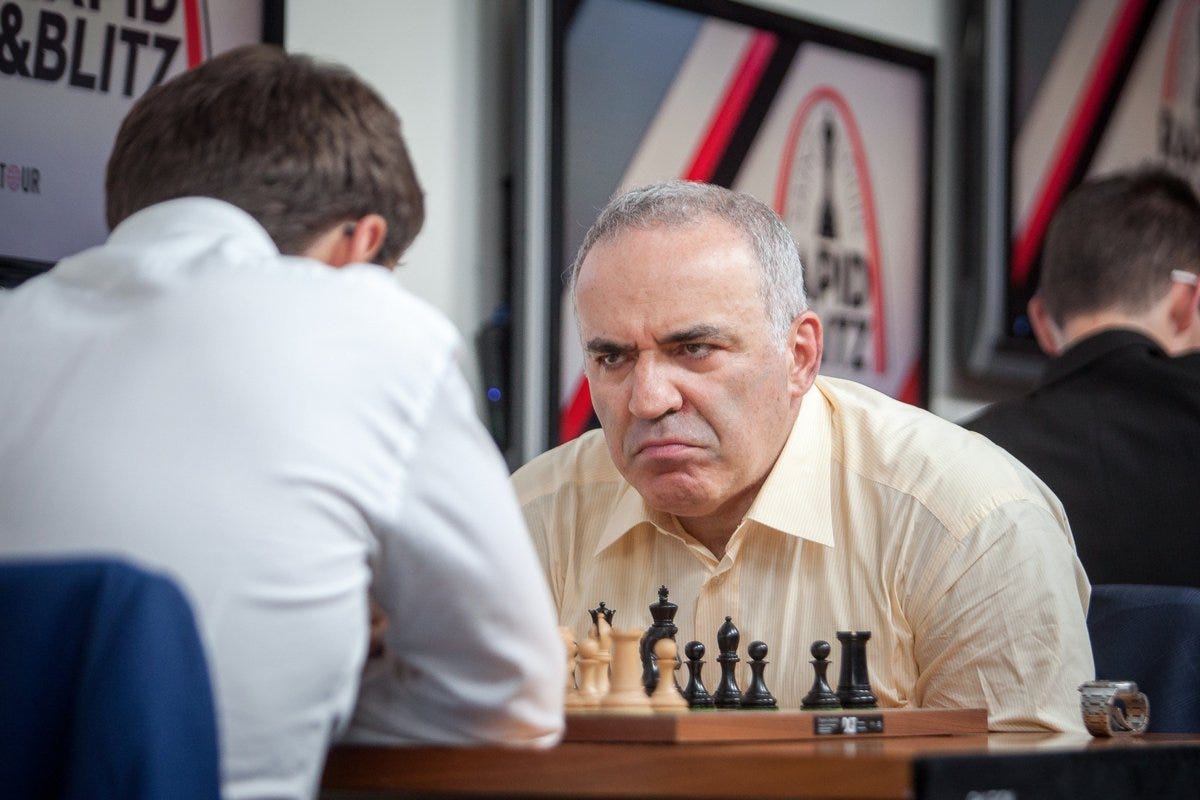
If Kasparov is Jordan, who is the chess version of Kobe? Well, Magnus Carlsen once said something uncannily similar to the Kobe quote:
“In actual fact I don’t have any clear preferences in chess. I do what I think circumstances require of me – I attack, defend or go into the endgame. Having preferences means having weaknesses.”
But the real answer is Vladimir Kramnik. The only person to ever beat Kasparov in a world championship match, he didn’t mind playing Kasparov. In fact, he enjoyed it. For him, chess was a game you played within yourself, and the goal was to get as good as possible. Kasparov was the toughest possible opponent, so playing him presented a golden opportunity.
This seemed to unnerve Kasparov. He arrived at the board, expecting to dominate his opponent’s ego, like usual. But Kramnik gave him nothing to hit at. (Given Kramnik’s recent turn towards anti-cheating paranoia, it’s odd to describe him as egoless, but it was a different era.)
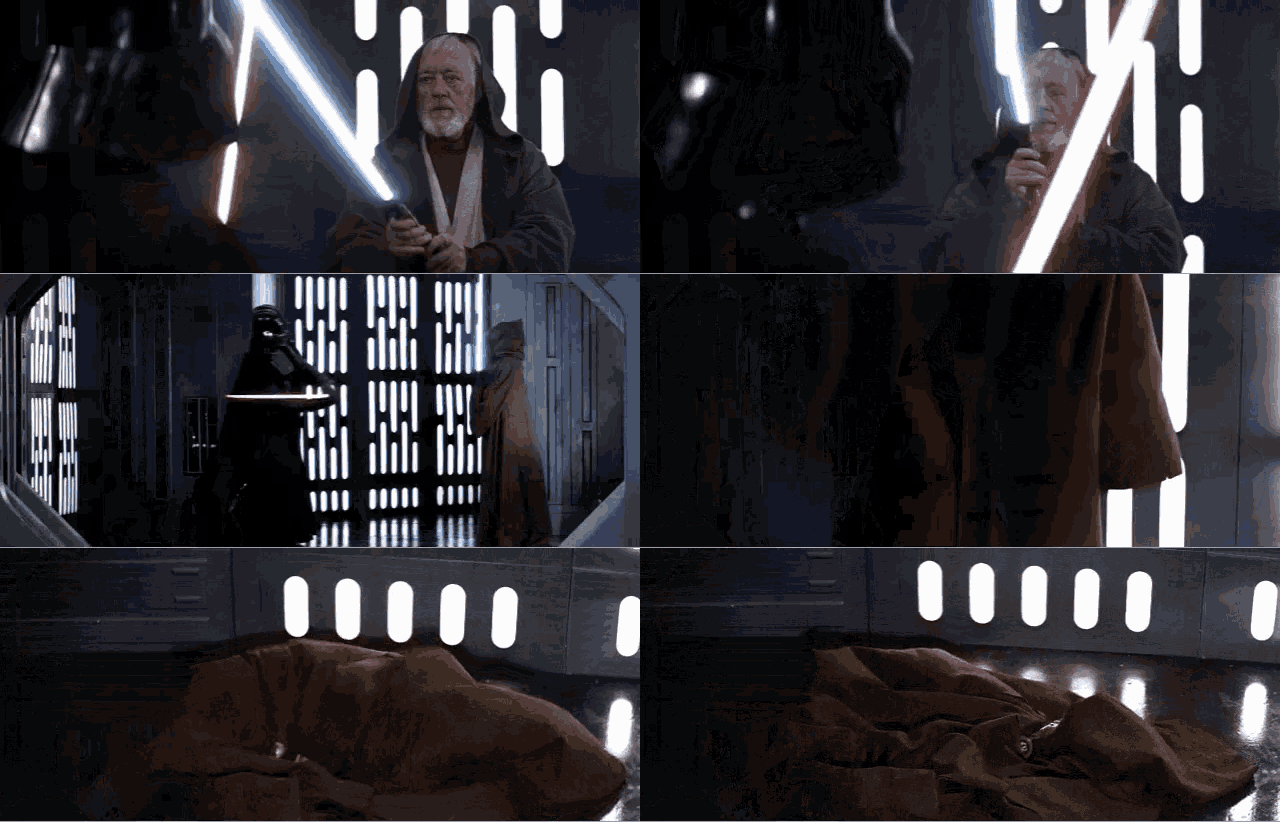
It’s like when Darth Vader cuts down Obi Wan, only to find… nothing there. As Obi Wan warns him, “If you strike me down, I shall become more powerful than you can possibly imagine.” If your opponent shows up expecting a battle of egos and you refuse to engage, it can be disconcerting. Upper hand: you.
It reminds me of this amazing compliment Andrew “LuckyChewy” Lichtenberger paid to Ike Haxton (two of the best poker players to ever do it) after losing to him at a final table.
“Ike is an unbelievably talented player. It’s hard to put into words, but he appears as a very formless opponent. When you think he is here, he is there - there, here. Certainly a master of deception in a game and format which demands just that.”
When I used to play poker professionally, managing my emotions was a big part of it. The luck factor in poker can produce huge swings. Sometimes you win big, but other times you lose it all, even if you do everything right. When this affects your financial situation, it’s hard to deal with.
Some players reacted to this by trying to shut off emotion and make themselves into robots, but this is a trap. Many people think that emotion is the opposite of rationality, but this is not actually how the brain works. Emotion is closely tied to all parts of decision making. You couldn’t turn off emotion if you tried, but if you could, it would be disastrous. In fact, if you try to stop feeling emotions, what you’re likely to do is become less aware of emotion – and therefore more in its thrall.
In The Feeling of What Happens, the neuroscientist Antonio Damasio described interacting with a patient who had the emotional processing centers in his brain destroyed by a traumatic brain injury. When he asked the patient if he would prefer to meet next Tuesday or Wednesday, the man listed pros and cons for 30 minutes without ever arriving at a decision. Far from making him a perfectly rational decision maker, losing his emotions destroyed his ability to make any decision at all. What Damasio believes is that, while the rational parts of the brain can provide analysis, it’s emotion that provides the final impetus for a decision.
The connection to time trouble in chess is painfully obvious. What seems to happen to many time trouble addicts in chess is that they are waiting to experience a certain feeling before they move. They want to feel certain, or at least confident, of their decision. This is Damasio’s emotional impetus. But in some challenging positions they never reach the level of comfort they’re craving. In that case, either they run out of time, or eventually their clock situation becomes so patently dire that they move even though they don’t want to.
Applying a sense of curiosity can help take the edge off. It won’t necessarily let you find the best move in a complicated position, but it may remove enough pressure to let you play some move and keep enough time on your clock to have a chance later on.
In the long run, most chess players will win about 50% of their games. If you get better, you’ll get paired against better opponents, and your win rate will stay around 50%. Unless you’re Magnus, I suppose.
If you only like winning, you’ll have fun in about half your games. If you like learning, you can have fun every game. I know this sounds like bullshit, but I’ve found it to be a highly pragmatic and effective way to enjoy chess more.
Get curious about chess itself. Try to understand what’s really going on in the position. If you want to get emotional, get emotional. There’s no harm in being interested in the game. If anything, it will probably help you make a better decision. If your opponent plays a good move, congratulate them. That’s a cool move. It’s not always about winning.
You’ll become more powerful than you can possibly imagine.
One thing I have learned in my own study is that I have a really hard time staying focused when analyzing for any length of time unless my curiosity is piqued.
If I’m trying to answer some question about a position such as “Is there a reason that pawn can’t be grabbed?” then I can dig in and look for a long time. I might come up for air and realize an hour has passed.
But if I’m trying to clinically look at a position to find the best move instead of trying to answer a question about it I quickly get tired and bored and just throw out random moves.
Super relevant and insightful... painfully so to me. I pride myself on being a rational decision maker. And frequently am the one in time trouble in 3+2 games. Am I _ignoring_ emotions that would help me make faster moves that are good enough?! Do I care too much, or not enough?