

When I was at a chess tournament, I saw a guy – let’s call him Greg – demonstrate a game at the bar one night. It was a fantastic performance: the game was interesting, he showed cool variations, and had great insights. He was also funny and charismatic.
A little later, I saw Greg posting on Facebook about financial struggles. He had interviewed for, but not gotten, a job at Chess.com. Short on money, he was trying to make ends meet by playing poker, but this wasn’t going well, and he was under a lot of pressure to support his family.
I didn’t really know him apart from having talked briefly at that tournament, but I thought I could offer some useful advice, having gone through a lot of the same things myself. For example, one thing I know is that if you need money immediately to pay the bills, poker is one of the worst things you can do. It’s very difficult to play at your best when you’re under that kind of pressure, and even if you do play well, it’s very easy to have a losing month. If you’re counting on that month’s income to pay the bills this is a huge problem.
If you find yourself in that situation, the best thing to do is get a job, play poker on the side if you have the time, and return to it when you’re in a more stable financial position (if that’s what you really want to do). I messaged Greg on Facebook, and we had a brief conversation.
A little while later, I saw there was a sale for Ramit Sethi’s “Find Your Dream Job” course. Two of my overarching life goals at this point are:
To be more open to serendipity
To be more generous
This seemed like a perfect opportunity to fulfill both. I thought it was odd that someone who was a master-level player and a very charismatic presenter couldn’t get a job at Chess.com. The most likely explanation seemed to be that Greg lacked some job interviewing skills, and this course would be the perfect way to develop them.
I messaged Greg again. I told him I had had really good experiences with Ramit’s courses, and while I knew the $1000 price tag for the course could be tough for someone who wasn’t in a stable financial situation, I would be happy to pay for half of it. His response:
“Thanks a lot. Right now I am not interested in something like this at all.”
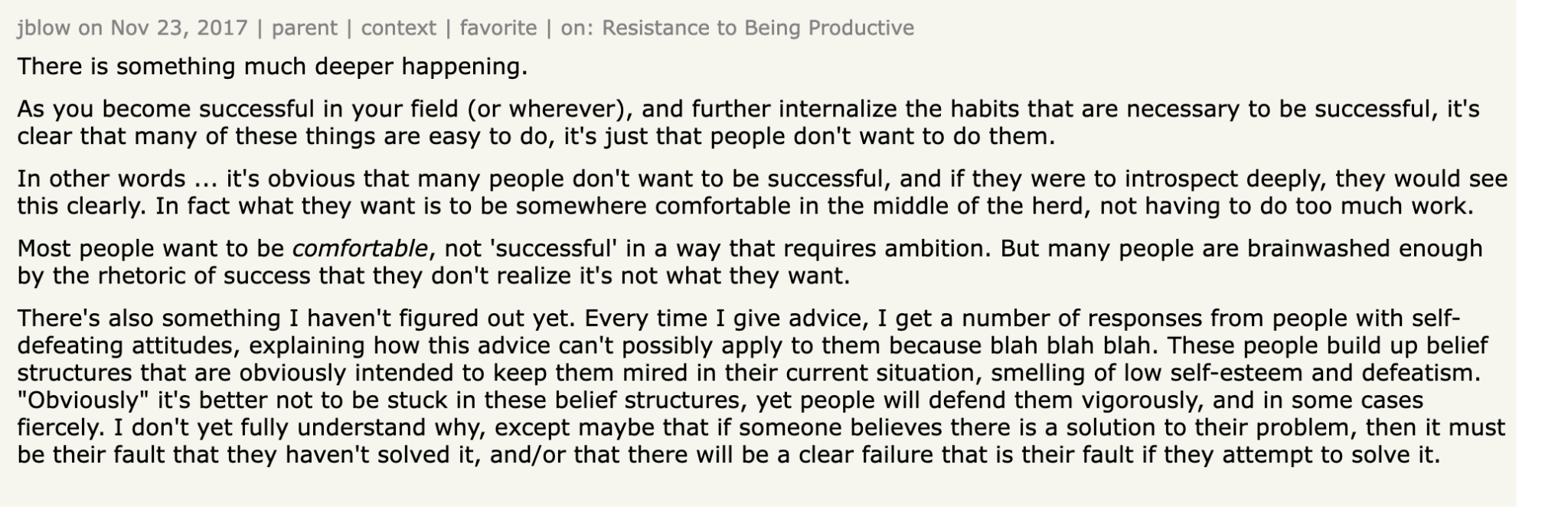
I’ve been thinking a lot about this post by the game designer Jonathan Blow. I see this so often when I post about chess on X. Whenever I give some advice about getting better at chess, no matter how practical and common-sensical it is, I usually get at least one person responding with how it couldn’t possibly work for them. Their arguments are usually quite implausible, but they’re deeply attached to them. I’m not sure if I agree with Blow’s argument for why people do this, but that they do it seems indisputable.
For example, I spoke with one player who believed his struggles involved complicated problems having to do with opening preparation. When I looked at his games, I found that quite often he was simply letting his opponents take his pieces. That is, the opponent would take one of his pieces and he would not recapture. I tried to explain that in chess you can’t give away material for free and that simply by committing to recapturing every time he could improve his results substantially. He had some very complicated and confusing reasons for why this wouldn’t work.
I’ve noticed that from the outside, many people have extremely obvious and simple changes they could implement that would improve their lives tremendously. Yet, the success rate for adoption when I point these out is close to 0%. Perhaps this isn’t surprising: If the change is really so obvious, the only reason they wouldn’t have done it already is if they have deep psychological factors blocking them. Probably, I should back off a bit.
What does all this have to do with the Benoni? Well, my friend and fellow Nebraska chess player JJ is a known Benoni aficionado. When Magnus Carlsen resigned after 1. d4 Nf6 2. c4 against Hans Niemann (this was meant as an anti-cheating protest, that’s a whole other story), he made one of my all-time favorite Twitter chess jokes, describing Magnus’s opening choice as the “Hyper Accelerated Benoni.”
The joke, to spell it out and thereby ruin it, is this: “Hyper accelerated” is a real opening naming convention, as in the Hyper Accelerated Dragon. The Benoni is such a bad opening that to hyper-accelerate it would mean skipping straight to resignation.
And yet, JJ plays the Benoni.
He also shared that sometimes in conversations his partner sometimes urges him to “stop Benoni-ing.” When I asked what this meant, he said, “Probably making things difficult for myself just because it’s perversely interesting or entertaining.” Thus, the Benoni has come to symbolize self-defeating tendencies, in chess and elsewhere.
Curiously, the Benoni (the opening) may not be a real example of this sort of spiritual Benoni’ing. It scores very well in the Lichess data, and to my astonishment, I even found myself recommending it to a student recently. This player has the unusual trait that he likes being attacked. He was happy with the Philidor against 1. e4, but had never found a defense against 1. d4 that he liked.
I started thinking, what is the equivalent to the Philidor vs. 1. d4? What opening is so provocative, so on-the-verge-of-losing, that it would virtually force the opponent to attack? The Benoni, of course. We did some quick prep and he beat his highest-ever rated opponent shortly afterward.
The good news is that if you currently have the Benoni in your repertoire (spiritually speaking), if you can somehow find a way to recognize this and make an adjustment, your whole life could change very quickly. So…how are you Benoni’ing yourself?
I had to start playing the Benoni to stop Benoni-ing myself. That’s cool. 😎 haha. 😂
David Maciver (Overthinking Everything on here, would recommend) occasionally phrases this as "have you tried solving the problem?"