

I never met him. I wish I did. I admired him greatly.
But like everyone, I saw the YouTube video of the game against Ivanchuk at World Blitz 2024.
There’s a fantastically complex endgame on the board. It would be difficult to figure out with an hour to think. They both have seconds. Ivanchuk seems to have the upper hand. Daniel knocks his king over and has to fix it.
But then Ivanchuk freezes. He doesn’t know what to do. His seconds are ticking down.
6…5…4…3…
To be good at chess you have to suspend your disbelief. Like when you walk into a movie theater, you know you’re not really watching a car chase or whatever, but you pretend for two hours.
You’ll have seen this if you ever played in a poker game or board game night. Some people get engrossed in the game, others zone out and watch TV. For some of the best players, suspension of disbelief doesn’t feel like an effort. The 64 squares are their whole world.
Ivanchuk is revered amongst chess players because he is the purest spirit in this way. At his greatest triumph, Linares 1991, first ahead of Kasparov, he couldn’t attend to the trophy ceremony. He was looking up at the ceiling, thinking about chess.
There’s something I tell my chess students sometimes: “You gotta have that dog in you.” It’s something football coaches say. It means football is a rough game and you have to be tough to play it well. This is true of chess, too.
But at the very highest level, you need to have the poet in you, too. You have to be open to impossible beauty. It’s like if, in a football game, all 22 players stopped the game and did a dance that was so beautiful that everyone in the audience cried. You don’t see that in football, but you do sometimes in chess, if you know how to look.
Chess is a rougher game than football. You wouldn’t know it unless you’ve played (really played, not just for fun), because it’s on the inside. Football hurts your brain too, sadly. But in football it’s because people hit you in the head. Everyone knows that.
Sometimes terrible things happen in chess. You get hurt when you lose. Sometimes you get hurt when you win. These injuries are emotional, not physical. That doesn’t make them less real. Sometimes it takes years to heal. Sometimes it never heals.
Once, my wife (then girlfriend) and I started playing a board game. Not chess, some other game. After we played once, I got interested in the game and started studying online. The next time we played, I won, of course. My wife was annoyed. She started probing the level of my competitiveness.
“What if you were playing a kid, and you already won once, and they started crying. Why are you laughing?”
“What if,” I said, “this scenario already happened?”
It had. I was tutoring at a boxing gym in Detroit. I started showing some of the kids chess. One kid cried after he lost, just like my wife described it. What was I gonna do, let him win?
Now I’m 40. I have a three year old son. If we ever play chess, I’ll let him win.
…2…1…0.
When Ivanchuk’s flag falls, he starts to weep. The spectators look embarrassed. They have a certain look on their faces that I don’t like. After a few seconds they walk away.
Daniel (or Danya, as he was called) is the only person who’s able to react appropriately. He bows his head, giving Ivanchuk space. There they are, a triptych. Ivanchuk weeping, the board, Danya bowed. He seems almost as distraught as Ivanchuk, but he doesn’t cry. Perhaps he’s waiting to see if Ivanchuk will offer a hand to shake. You’re supposed to do that after the game, but obviously these aren’t normal circumstances.
The spectators start to come back. They have nervous smiles on their faces. It’s very unpleasant. After a minute or two, Danya quietly stands and walks away. He handled the situation perfectly. He didn’t say a word, but he was present. Few people could have done that. But few people could have known what Ivanchuk was going through. No one embodied the dog and the poet like Danya.
Ivanchuk lays his head down on the board, still weeping.
There’s something you might not know about Ivanchuk. There was this game against Yusupov. Candidates 1991, on the way to qualifying for the world championship match. Ivanchuk was playing the game of his life, maybe the best game by anyone, ever. On move 25, he could move either knight to e7.
For deep and complicated reasons, one knight move won, the other did not. Ivanchuk thought for a long time and figured it out. He had seen everything. Then he touched the wrong knight. In chess, there’s a touch move rule. If you touch a piece you have to move it. He knew it was the wrong knight. He had to move it.
Yusupov won the game and the match. Ivanchuk never competed for a world championship. Sometimes it never heals.
Danya died yesterday. We don’t yet know the cause of death. What we do know is that for over a year he had been the target of outrageous cheating allegations by Vladimir Kramnik, a former world champion who has descended into anti-cheating paranoia. To any reasonable person watching from afar, it was clear that Kramnik’s accusations were baseless, but these allegations seemed to bother Danya deeply.
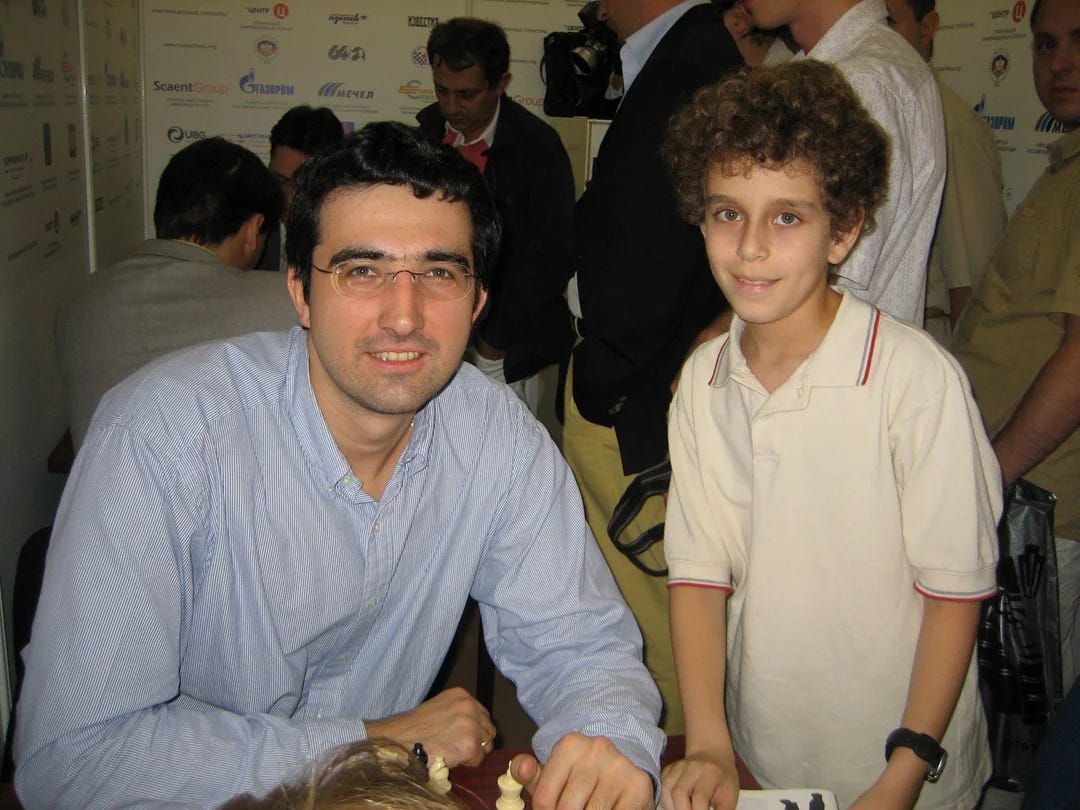
Kramnik was a victim, too. In his 2006 world championship match against Veselin Topalov, Topalov’s manager claimed Kramnik was using his personal bathroom too often. He suggested there could be computers hidden in there. It was nonsense, of course, just like Kramnik’s cheating allegations against Danya.
But Kramnik was so offended he did not show up for game five as a protest. He was forfeited, but came back to win the match. A strong person and strong chess player. He seemed to shrug it off. We called it Toiletgate and laughed about it. In retrospect, it wasn’t that funny.
I interviewed Kramnik for an article a few years ago. He didn’t know who I was, but he was kind and gracious. Something broke in him after that. Maybe it was broken all along on the inside. Sometimes it never heals.
Over the last thirty or so years, chess computers (we call them engines) have gotten really good. It took a super computer custom-built by IBM, Deep Blue, to beat Garry Kasparov in 1996. Now you can download an app on your phone that could crush Deep Blue or Kasparov.
This created a big problem with cheating, especially in online chess. Anyone could just look at their phone and win. You wouldn’t even have to be good at chess. No one knows how many people are doing this. Chess.com says not that many, they can tell, but a lot of people don’t believe them.
Kramnik is one of those people. He started playing in an event Chess.com runs called Titled Tuesday. At first it was fun, but he became convinced people were cheating against him. Everyone knows this is a possibility, but it triggered something darker in Kramnik.
He started accusing people. There were a lot, but he seemed to target the most vulnerable. It’s like he could sense it. People with lower status or mental illness. Or maybe he just accused everyone. Sometimes it never heals.
I went through this thing with my health. I was chronically ill for most of a year. I finally got the right diagnosis and treatment, which starts with steroids. Now I feel great, but I’m manic from the steroids. I also can’t sleep more than four hours a night.
So obviously, I started playing a ton of late night speed chess. After a few days of that I got bored and switched to writing. I don’t think Danya could get bored of chess.
Once I had four hours every night to write, my newsletter started growing quickly. Suddenly, I had become very powerful. Not in terms of influence, it’s still small that way, but in terms of what I could accomplish. I got interested in powerful people like Elon Musk.
One thing I tried when I couldn’t sleep was listening to Harry Potter on audible. On this listen, I was most interested in Voldemort. “He did great things,” says the wandmaker Ollivander. “Terrible, yes, but great.”
Voldemort. Bad dude, but kind of funny. Always getting mad at his henchmen. Real flare for the dramatic.
Kramnik stopped being funny a long time ago. When someone goes bad in real life, it’s not funny.
There’s something about the fearful symmetry – one man spewing hate, another man, kinder and gentler, receiving it halfway across the world, both unable to log off – that I cannot yet put into words.
When I started writing this, I thought, of course, that Kramnik was the dog and Danya the poet. But now I can see it was both of them. It had to be both of them all along.
I don’t know what happened to Danya. Like I said, I never met him. But sometimes it never heals.
Thanks, Nate. Really well written. I know it’s hard to take stock so soon after a tragedy like this, but I think you did so with real grace and more grace than I would feel capable of at the moment. I can’t help but think that, whatever the cause of death, natural or otherwise, Kramnik should be held responsible for his campaign against Danya and others. I know it won’t happen - it’s real life, not a story - but that doesn’t stop me from wanting it.
This piece is really something special, thank you for writing it.