

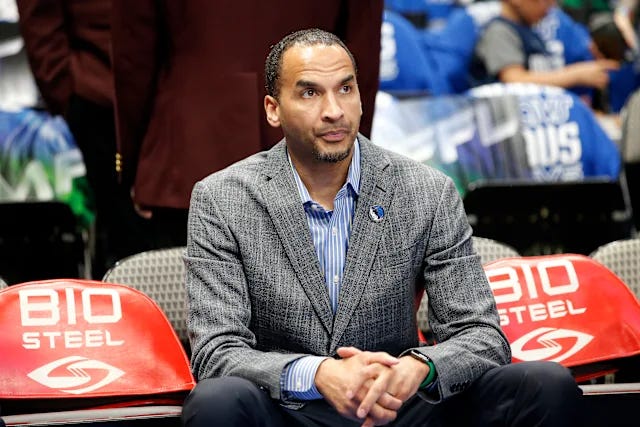
Nico Harrison, the general manager of the Dallas Mavericks, was fired last week. Harrison made one of the most shocking trades in NBA history, dealing Luka Doncic to the Lakers for Anthony Davis.
What made the trade so shocking was that Luka had been considered by almost everyone to be a top-five player in the NBA, and at the age of 26, he was just entering his prime. Basketball is a top-heavy sport: it’s incredibly important to have the best player. This is because there are only five players on the court, your best player can play most of the game, and you can put the ball in his hands. Conventional wisdom says that to win a championship, you need a top-five player in the world. These players are very hard to get (there’s only five of them), and they’re generally not available for any price.
What seems to have happened is that Harrison and Mavericks leadership became frustrated with what they perceived as Luca’s poor work ethic. In an interview, Mavericks owner Patrick Dumond (who clearly had to sign off on the deal), said: “In my mind the way teams win is by focus, by having the right character, by having the right culture, and having the right dedication to work as hard as possible to create a championship-winning outcome. And if you’re not doing that, you’re going to lose.”
Anthony Davis, the player Harrison got in return for Luka, is a great player, but clearly not a top five guy at this stage of his career. At 32 years old, he has a long track record of injury problems. For these reasons, the trade was widely panned at the time by NBA insiders.
The outcome was even worse than anyone could have imagined. Almost immediately, Davis got hurt and had to miss extended time. Additionally, Kyrie Irving, the other best player remaining on the Mavericks, suffered a devastating knee injury that would take him out at least a year.
Even accepting that Harrison had chosen to move on from Luka, he inexplicably failed to shop him for the best deal, or to create a balanced roster with multiple ball handlers and creators. This put an unreasonable workload on the 33-year-old Kyrie and may have contributed to his injury.
When the NBA draft rolled around, the pendulum swung back in the other direction. The Mavericks had gotten so bad that they had a small but non-zero chance to land the top pick in the draft, which they luckily hit and got the right to select Cooper Flagg, considered by many a generational talent. Having voluntarily parted with one top-five player, through sheer luck they got a chance to acquire (potentially) another.
This year, with Kyrie still out, the team has looked like a mess. Everything is on the shoulders of the rookie Flagg. He’s game, but there doesn’t seem to be any vision for how the team should operate on a strategic level. Things finally came to a head with the firing of Harrison.
What’s interesting to me about this whole saga is how elements of skill and chance interact. There’s now a small but vocal contingent saying that Harrison got a raw deal that maybe he didn’t deserve to be fired. Call me crazy, but I’d say that if you make the worst move in the history of your field – which the Luka trade was – you should probably get fired.
But it’s also true that Harrison got unlucky. He made an insanely bad trade based on information that was available at the time, but he also got unlucky, and it turned out even worse than it should have. Davis and Irving are both aging players with a history of injury, but even so, it wasn’t preordained that they would both suffer severe injuries so quickly. Harrison put himself in a position to be exposed to above-average injury risk, but he got hit with an outcome near the bottom of the range of possibilities.
Humans tend to think in binaries, but for any “either/or” question, the correct answer is usually “both.” It’s not luck or skill, it’s always both. When you see a very extreme outcome, it’s likely that luck and skill are pulling in the same direction. In the case of the Mavericks, going from a promising franchise that had just made the NBA Finals to a shitshow that had to fire their general manager in one year required a historically bad trade and a stretch of bad luck. Similarly, Elon Musk is probably both very smart and very lucky. To achieve an extreme outcome like being the richest man in the world requires being extreme along all dimensions.
As my friend Jennifer Shahade, who just finished third in a poker tournament for $291,800, observed: “Of course, such things [preparation] only matter so much. To succeed in this poker tournament, I needed a lot of luck.” Jennifer is an amazing poker player, but she also knows that to finish near the top of a tournament with hundreds of players takes luck, no matter how good you are.

The same thing applies in chess: it has more luck than most people imagine. Or if you have a problem with the word luck, call it variance. The point is you can’t predict the outcomes, and they’re not always under your control. To win a tournament with a lot of players, even if you’re the best player there, takes some luck. You can’t expect to win every time, there are too many variables outside your control.

The takeaway for chess players is not to get too hung up on one result, one game, one tournament. Even in chess, seen by many as the supreme test of skill, anything can happen in a single game or tournament. Look at the World Cup currently underway, where only two of the top ten seeds have made it into the quarterfinals. Skill matters, but mostly in the long run. So keep working and don’t sweat any individual result too much.
Thanks for this piece. This is a heady way to look at things. There’s a lot of variables involved in most sports decision. When thinking about Harrison. He was unlucky. If a player isn’t working hard then you get rid because you need a standard. Shame about the injuries.
With regards to Chess. Variables or lack of them are so key. This is why calculating is so important. It’s a hard skill that needs honing because trying to predict what an opponent will do is tantamount to impossible.