

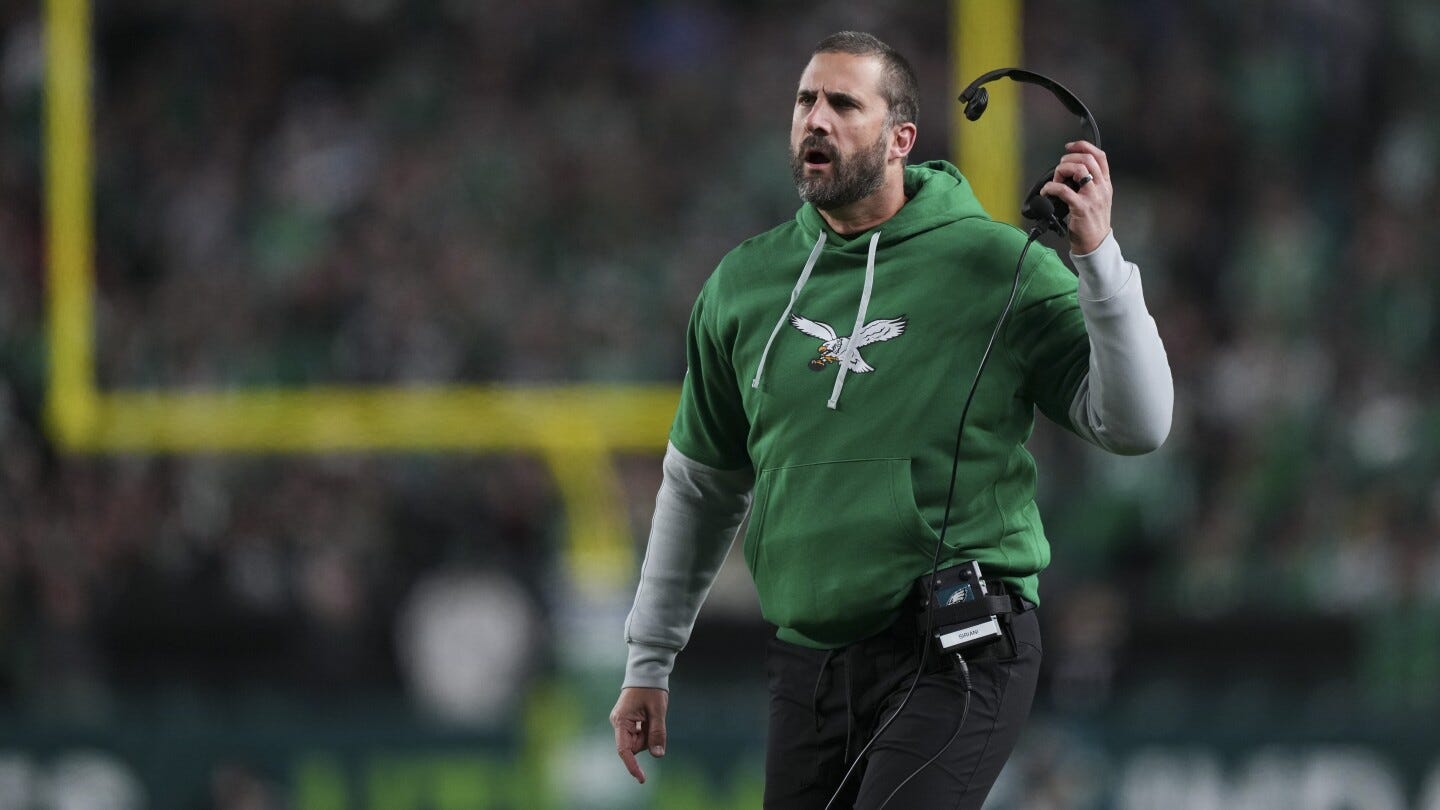
In last week’s NFL game between the Bears and Eagles, the Eagles scored a touchdown to get within nine points with 3:10 left. Head coach Nick Sirianni called for a two-point conversion to try to get within seven, but when the attempt failed, the Eagles remained down nine, and the game was essentially over. Predictably, fans on social media criticized the decision, but Sirianni made the right call, and it’s not particularly close.
As commentator Greg Olsen explained, “Philly trailed by 15. That’s a 2 score game slightly less than 50% of time (2pt success rate). It’s a 3 score game the remaining %. You want to know as early as possible how many possessions you need.”
The point is that to tie the game, you’re going to need another touchdown and a two-point conversion. You can either go for the two-point conversion now or when you get the next touchdown. If you fail the two-point conversion, you’re probably screwed either way, but by going for it immediately, at least you get that information as soon as possible. That gives you the chance to try an onside kick to get the ball back. It’s not a great chance, but it’s better than nothing. And if you waited to try the two-point conversion, you wouldn’t have known you needed it until too late.
Many commentators derided Olsen’s tweet as “analytics,” but it’s not really even analytics, which involves data and observation. It’s just logic and math. The logic is fairly straightforward, but most people don’t like it. If you scroll through the responses to Olsen’s tweet, you’ll see that a large majority disagree with it.
The top response came from lineman JJ Watt:
“Analytically, that is absolutely correct. The counterpoint would be the human element of a team’s mindset/mentality only being down one score instead of two. Right or wrong, there is some unquantifiable aspect to the belief & confidence of knowing you’re only down one score”
Watt’s point seems to be that if you stay down by “one score” (8 points instead of 9 points) your team will play harder. If this is actually true, it points to a much bigger problem than these kinds of marginal 2-point conversion decisions. If your players are so emotionally fragile that you have to avoid obviously correct strategic decisions to protect their feelings, then you have a huge problem with mental toughness. It’s amazing to me that tough guys like Watt are so willing to tolerate and even embrace this level of psychological fragility.
But to take a step back, it’s interesting to think about why so many people seem to be opposed to going for two, even though the logic in favor of it is fairly straightforward. There seem to be two things going on:
The first is results-oriented thinking. Of course, on some level, you have to be results-oriented: results are what count in the real world. But in high-variance situations like going for a two-point conversion, the results don’t tell you much. Of course, you knew all along a failed attempt was a possibility. The fact that the attempt failed in this particular instance doesn’t tell you much about the quality of the decision.
The bigger issue though is risk aversion. If you read through the responses, it seems that most people don’t think in terms of maximizing their win percentage. Instead, they bucket the game state into two categories:
Already over
Still a chance
Their goal is to keep the game in the “still a chance” category as long as possible. The main priority is to delay the moment of reckoning. What I think this ultimately comes back to and where it ties into chess is fear of failure.
I recently gave a simul at a local public library. I was doing the simul for a kid’s club, but as it turned out, there weren’t quite enough kids there to fill all the boards. We had two boards left, and I told the parents that they could play if they wanted to. As soon as I made this offer, the fear and discomfort in the room was palpable. Ultimately, only one mom was brave enough to sit down at one of the boards. The other board remained empty.
This might sound odd, but in my day-to-day life, I don’t have a lot of occasion to interact with normal adults “in the wild.” Most of my workday is writing on my computer or teaching lessons online. The rest of my day is mostly chores and taking care of the kids. When I do interact with adults in a group setting, I am often taken aback by how fearful they are: fearful of appearing different, and especially fearful of failure.
This is a good thing to remember when it comes to chess improvement. For most adults, the biggest hurdle is not learning how to play against an isolated queen pawn or whatever. It’s accepting the possibility of failure. Given that everyone has to lose thousands of games to get really good, embracing failure is absolutely essential.
In poker, there is a word for people who are too risk-averse. We call them nits. A nit is someone who’s risk-averse to the point that it limits their own opportunities. They avoid profitable plays or bets because they’re too scared.
While popular wisdom would suggest that math and strategy usually point in the direction of the conservative option, the actual math often goes the opposite way, as in the case of Sirianni’s two-point try. This is certainly true in poker, where solvers (poker’s version of chess engines) play far more aggressively than virtually any human. It’s true in chess as well, where advanced neural network engines like LeelaZero are ultra-aggressive.
And in fact, for most people, their emotions often pull them in the direction of excessively conservative approaches. Compulsive gamblers are real, but they’re a minority of the population. Most people prefer to stay in a their comfort zone.
One example from chess is a final round game when many players are tied for first going into the round. The more players in the tie, the stronger the incentive to go all out for a win, because the higher the chances that at least someone will in fact win. And yet, most chess grandmasters are uncomfortable with this “win at all costs” type of mentality. They’re so accustomed to making draws that it’s hard for them to flip the switch.
At the amateur level, it’s less about tournament strategy and more about simply showing up on a consistent basis. Playing games with full focus, going to tournaments, focusing on the real weaknesses in your game. Most people are too scared of failure to even try. Just by trying, you can give yourself a huge advantage over almost everyone.
Great piece Nate, as an Eagles fans, I heard a few people grumbling about the 2 point conversion decision and it surprised me. Could not articulate as well as you why it is correct.
As a Bears fan, I loved getting the info early on the failed 2 point try so I could relax the last 3 minutes of the game! I do wonder if my generation of sports fan (I'm 61) will be the last to bitch about analytics. As we know, there are many hidebound traditions in sports that don't make sense. Like bunting with runners on first and second with nobody out...ugh.